

Differentiating Sharp Action From Public Sentiment
The first time I noticed odds movement on a UFC fight, I had no idea what I was looking at. A fighter opened at 2.40 on Monday morning and by Thursday afternoon the price had drifted to 2.80. Nobody I followed had mentioned an injury. No news had broken. Yet the market was telling me something — loudly — and I was too inexperienced to hear it. I bet the original price out of stubbornness and lost. The fighter looked flat, disengaged, and was finished in the second round. Weeks later I learned he had been dealing with a back injury that only his camp and a handful of sharp bettors had known about.
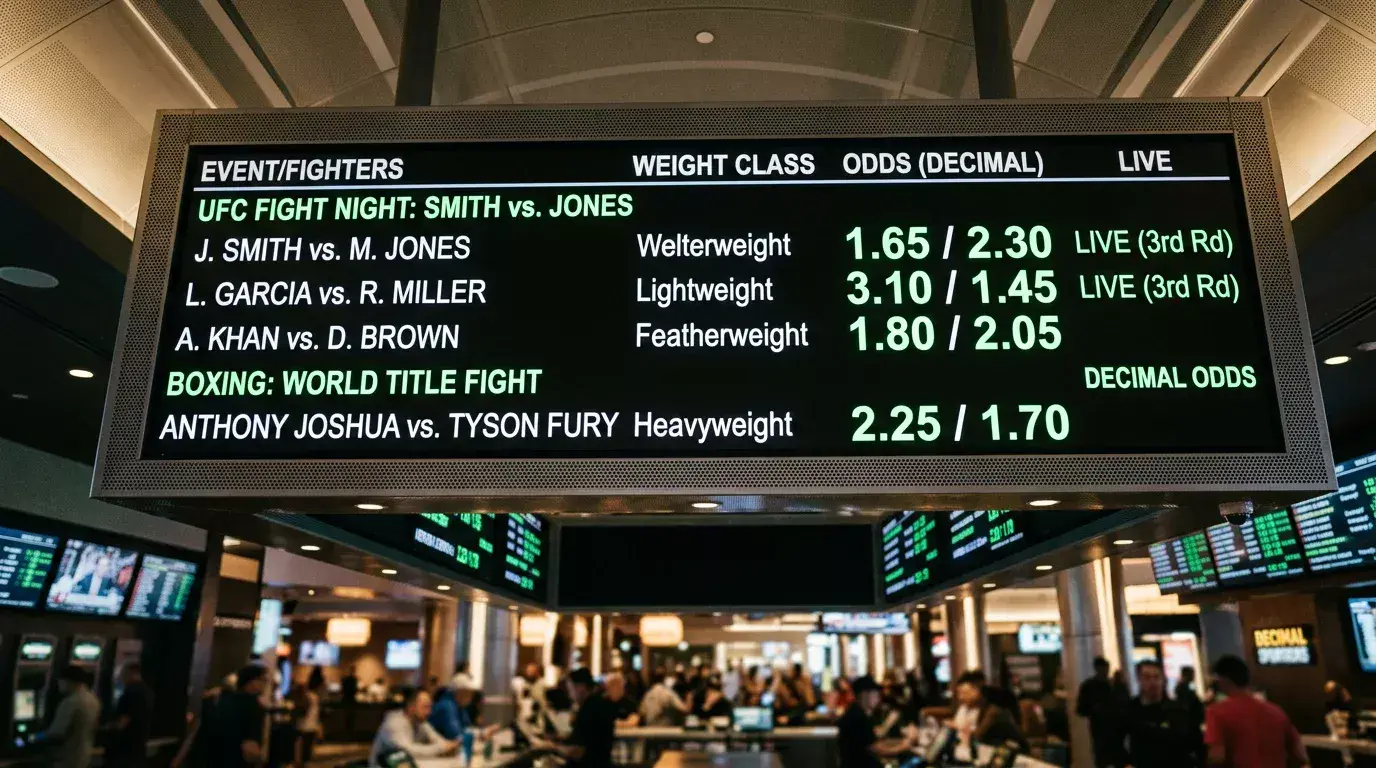
MMA betting handle reached $10.3 billion in 2024, and that kind of volume does not move through a market silently. Every dollar placed on a UFC fight carries information — sometimes explicit, sometimes implied — about the bettor’s assessment of the fight. When enough informed money pushes in one direction, the line moves. Learning to read that movement is one of the most valuable skills an MMA bettor can develop, because the line itself is a crowdsourced probability estimate that updates in real time.
What Causes UFC Odds to Move
Odds move for three reasons, and distinguishing between them is the entire game. The first is new information. An injury report, a confirmed weight-cut issue, a gym change, a late replacement — any verifiable development that changes the probability of either fighter winning will move the line if enough bettors act on it. This is the most straightforward form of line movement and the one that casual observers understand intuitively.
The second reason is sharp money. Professional bettors — the ones with long track records of beating the closing line — place their bets early in the week, often within hours of the lines opening. Sportsbooks track these accounts and respect their action, sometimes adjusting the line immediately after a single large bet from a known sharp. Sharp money does not always reflect private information. Sometimes it simply reflects a better model — a more accurate probability estimate derived from more rigorous analysis. But the sportsbook cannot distinguish between information-driven and model-driven sharp action, so it responds to both by moving the line.
The third reason is public money — the aggregate weight of recreational bettors placing their wagers based on name recognition, highlight reels, social media hype, or gut feeling. Public money tends to arrive later in the week, especially on Friday and Saturday, and it pushes lines toward the popular fighter. Sportsbooks will allow public money to move a line only so far before shading it back toward the sharp-derived price, but in the interim the distortion creates opportunity.
The UFC’s integrity partner IC360 monitors wagering activity on every event, and in November 2025 the bout between Dulgarian and del Valle was flagged for anomalous betting patterns — Caesars, William Hill, and DraftKings voided all wagers on that fight. That case illustrates how extreme line movement triggered by suspicious activity can be identified and acted upon by the market’s surveillance systems. For bettors, the lesson is that not all line movement is created equal, and movement driven by insider manipulation looks different from movement driven by legitimate sharp analysis.
Steam Moves and Reverse Line Movement in MMA
A steam move is a sudden, dramatic shift in odds — typically several percentage points of implied probability within minutes — that occurs when a group of sharp bettors hits the market simultaneously. In MMA, steam moves are rarer than in football or basketball because the betting volume is lower and the number of sharp MMA bettors is smaller. But when they happen, they are extraordinarily informative.
A steam move on a UFC fight almost always carries genuine signal. The small community of sharp MMA bettors is tight-knit, and when multiple sharps reach the same conclusion about a fight, they tend to act at similar times — often immediately after a piece of information becomes available. A credible injury report released on Wednesday morning can trigger a steam move by Wednesday afternoon as every sharp in the market adjusts their position.
The practical challenge is speed. Steam moves resolve quickly — sportsbooks adjust their lines within minutes, and the value window closes before most recreational bettors are even aware the move happened. This is one reason that having accounts at multiple sportsbooks matters: different operators adjust at different speeds, and the last one to move offers the best remaining price. On several occasions I have captured significant value simply by being logged into a slower-moving sportsbook at the moment a steam move started at the faster ones.
Reverse line movement in MMA follows the same logic as in other sports but is amplified by the sport’s unique characteristics. MMA has a smaller and less sophisticated public betting population than football, which means the gap between public sentiment and sharp assessment can be wider. When a UFC fighter becomes a social media sensation — a viral knockouter, a trash-talking heel — the public overloads the market with emotional money, and the sharps quietly take the other side. The line moves toward the sharp position despite the public imbalance, creating a visible reverse movement pattern that is one of the most reliable signals in MMA betting.
The discipline required is patience. Not every line movement demands a response. Most movement is noise — small adjustments reflecting the normal flow of money through the market. The movements that matter are large, early, and against expectations. If you can train yourself to act only on those movements and ignore the rest, you will find that the line tells you more about a fight than any single analyst ever could.