

Real-Time Scoreboards and Broadcast Betting Integrations
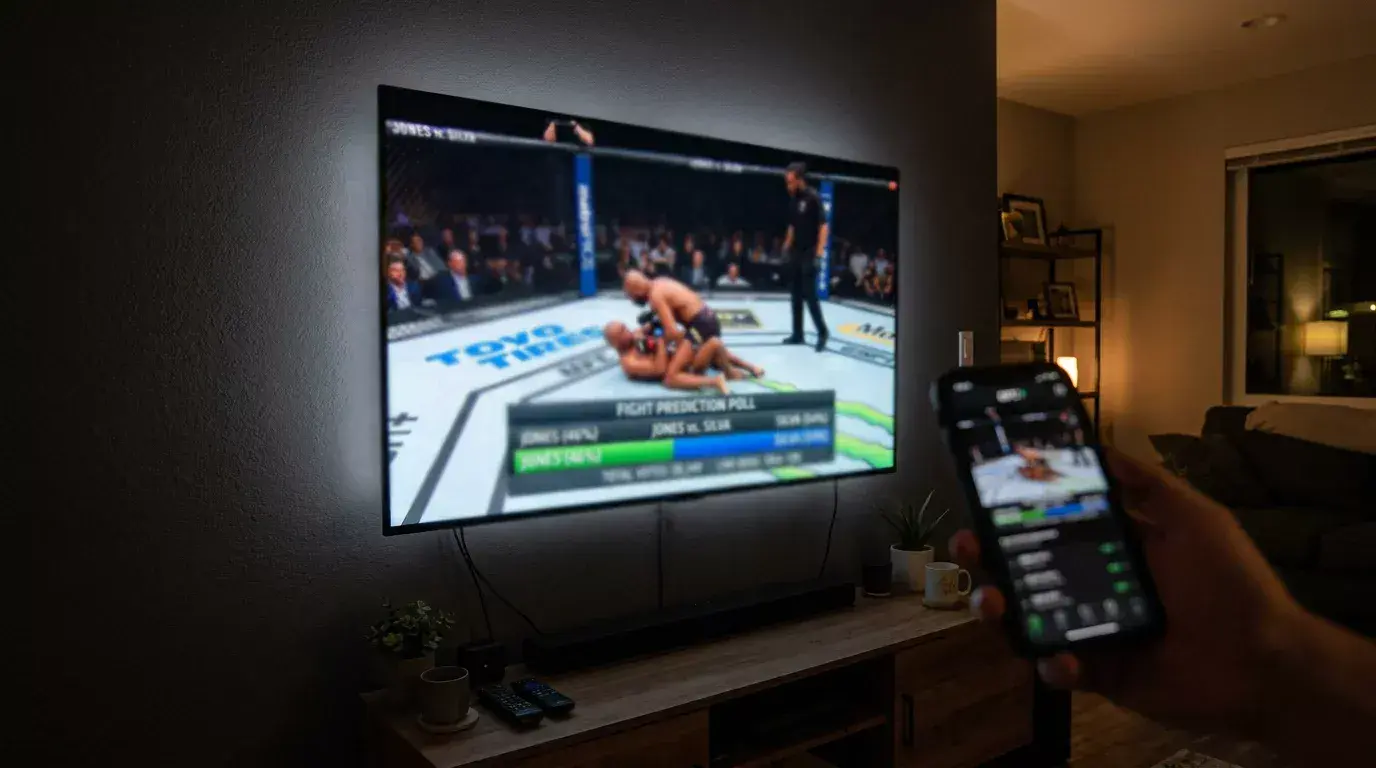
When the UFC announced its partnership with Polymarket in November 2025, integrating a prediction scoreboard directly into Paramount+ broadcasts, it marked a shift that went beyond marketing. For the first time, a major combat sports organisation was embedding real-time probability data — derived from a decentralised prediction market — into the viewing experience itself. Fans watching at home could see, live on screen, what the crowd of bettors collectively believed about who would win each fight.
That integration was not subtle. It appeared during broadcasts as a visible overlay, turning passive viewers into participants who could see how market sentiment shifted round by round, punch by punch. The implications for traditional MMA betting are significant, not because Polymarket replaces sportsbooks — it does not, particularly for UK bettors — but because it introduces a new layer of price discovery that feeds information into the broader market ecosystem.
The UFC-Polymarket Deal: Structure and Integration
The partnership centres on Polymarket’s prediction scoreboard, a real-time display of market-derived probabilities for each fight on a UFC card. Polymarket operates as a decentralised prediction market built on blockchain infrastructure, where participants buy and sell shares representing different outcomes. The price of each share reflects the market’s collective probability estimate — if shares for Fighter A trade at 0.65, the market implies a 65% chance of victory.
TKO Group Holdings CEO Ari Emanuel described the vision as transforming passive viewership into active participation. The scoreboard does exactly that — it gives casual viewers a reason to engage with probability data that was previously accessible only to bettors who actively sought it out. For the UFC, the commercial logic is straightforward: deeper engagement with the betting layer increases the sport’s value to media partners, sponsors, and sportsbook operators who pay for broadcast integration.
What makes the Polymarket integration different from existing in-broadcast betting promotions is the data source. Traditional broadcast betting integrations display odds from a specific sportsbook partner. Polymarket’s scoreboard displays prices derived from a decentralised market with no single operator setting the line. The prices move in real time based on actual trading activity, which means they can diverge from traditional sportsbook odds — and those divergences are informative.
Prediction Markets vs Traditional Sportsbooks for MMA
The core difference between a prediction market like Polymarket and a traditional sportsbook is the pricing mechanism. A sportsbook sets opening odds, adjusts them based on incoming bets, and builds in a margin that guarantees profit regardless of the outcome. A prediction market has no house — participants trade with each other, and the price is determined by supply and demand with the platform taking a small fee on winning positions.
For MMA, this distinction matters because prediction markets can capture information that traditional sportsbooks resist. A sportsbook that receives a large bet from a sharp account will move the line, but it may also limit or close the account to reduce its exposure. A prediction market has no account-limiting mechanism — any participant can buy as many shares as they want, at any time, and the price adjusts purely on volume. This means that prediction market prices can, in theory, incorporate sharp information faster and more completely than sportsbook prices.
MMA betting handle through traditional channels reached $10.3 billion in 2024, and the prediction market volume on UFC fights is a fraction of that. But the signal-to-noise ratio in prediction markets can be higher because the participants tend to be more information-driven and less sentiment-driven than the general public betting population. When Polymarket and sportsbook odds diverge on a UFC fight, the divergence is worth investigating — it may reflect information that prediction market traders have absorbed before traditional bettors.
The limitation for UK bettors is that the broader market context around Polymarket is complicated by regulatory considerations. Crypto-based prediction platforms operate outside the Gambling Commission’s licensing framework, which means UK residents face restrictions on participation. The value of the UFC-Polymarket partnership for UK bettors is therefore informational rather than transactional — you can watch the scoreboard, analyse the price movements, and use the data to inform your bets at licensed UK sportsbooks, but participating directly in the Polymarket itself requires navigating a regulatory grey area that I would not recommend.
What This Means for MMA Bettors in the UK
The Remote Gaming Duty increase to 40% in April 2026 — the largest single tax hike in UK gambling history — is already putting pressure on operator margins. In that environment, the additional price-discovery layer that prediction markets provide becomes more valuable, not less, because it gives bettors another data point for evaluating whether the odds at their licensed UK sportsbook represent fair value.
The practical workflow is simple. Before placing a bet on a UFC fight, check the Polymarket scoreboard or equivalent prediction market data alongside your sportsbook odds. If the prediction market prices align closely with the sportsbook, the market is in consensus and the odds are likely efficient. If they diverge meaningfully — Polymarket gives Fighter A a 60% chance while your sportsbook implies 52% — there is a gap worth investigating. The gap might reflect superior information in the prediction market, or it might reflect different participant demographics and risk tolerances. Either way, it is a signal your analysis should account for.
The bigger picture is cultural. The UFC-Polymarket partnership normalises probability data as a core part of the viewing experience. Casual fans who see a prediction scoreboard on their screen will start thinking about fights in probabilistic terms, even if they never place a bet. Over time, this increased probability literacy among the fan base will make the overall betting market more efficient — which is bad for bettors who rely on public ignorance but good for bettors who rely on analytical rigour. The market is growing up, and the bettors who grow with it will be the ones who survive.
A survey conducted in February 2026 found that 68% of UK gamblers expect to increase their betting activity over the year — a rising tide that will bring more volume, more information, and more competition to every market, including MMA. The prediction market layer adds to that competitive pressure by making probability data accessible to a wider audience. The bettors who treat this as a threat are thinking about it wrong. It is an opportunity — one more tool in a toolkit that is only as strong as your willingness to use it.