
Identifying Vulnerable Fighters After Extreme Dehydration
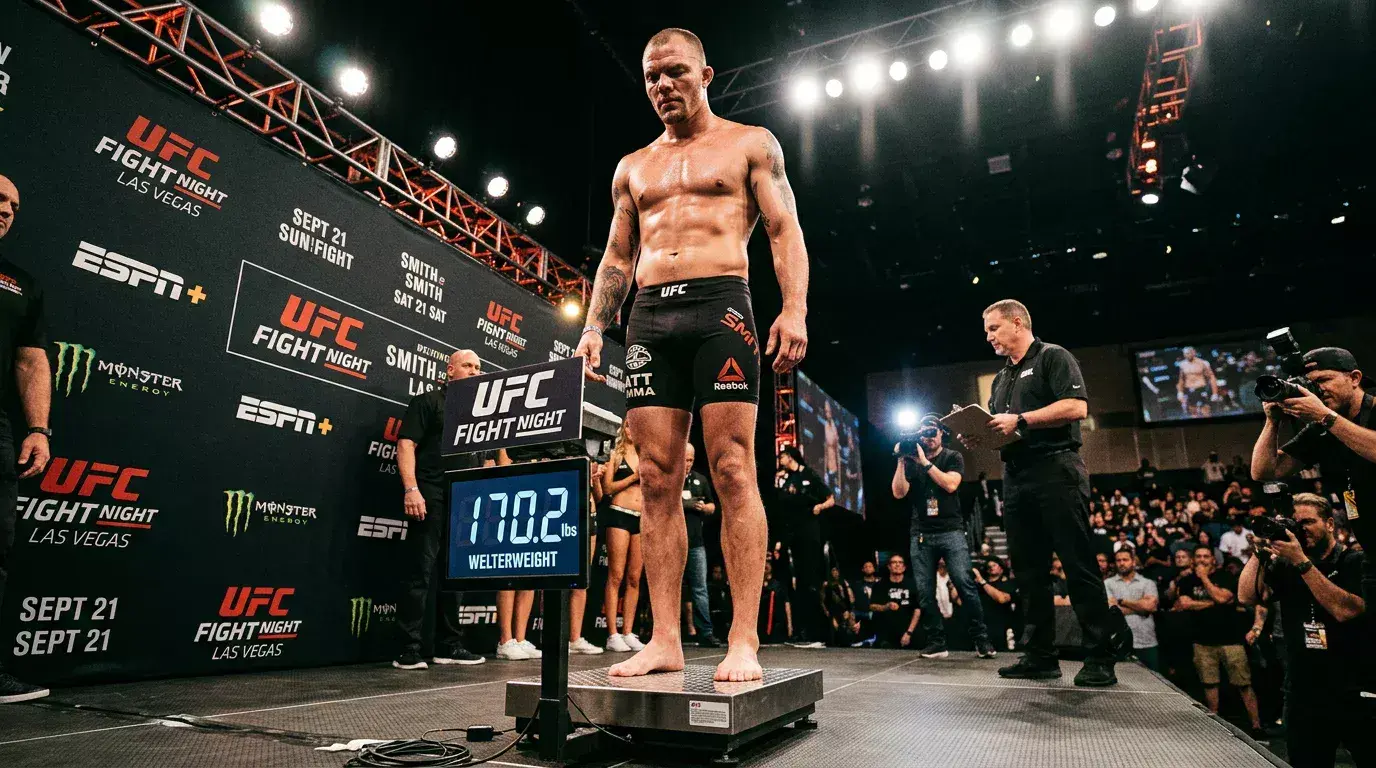
I once watched a fighter step onto the weigh-in scale looking like a man who had not slept in three days. Hollow cheeks, sunken eyes, visibly trembling hands. He made weight by a tenth of a pound. Twenty-four hours later, he walked into the octagon fifteen pounds heavier — and lost in the first round to a body shot he would normally have absorbed without flinching. The weight cut had hollowed him out, and no amount of rehydration could restore what the dehydration had taken.
That fight changed how I approach MMA betting. Weight cutting is the hidden variable in nearly every UFC bout, yet most bettors treat weigh-in day as a formality — a box-ticking exercise that confirms both fighters are eligible to compete. In reality, the weigh-in is one of the most information-rich moments in the pre-fight timeline, and it tells you things about fighter condition that no training camp report or statistical model can capture.
Every weight class in the UFC involves some degree of cutting. The question is never whether a fighter cuts weight but how much, how hard, and how well their body recovers. The answers to those questions have direct, measurable effects on fight-night performance — effects that show up in the betting outcomes if you know where to look.
What Happens to a Fighter’s Body During a Weight Cut
The physiology is straightforward but brutal. Fighters spend the final days before weigh-in rapidly dehydrating their bodies to hit a contractual weight limit. The methods include water loading followed by water restriction, sitting in saunas, wearing sweat suits during light exercise, and in extreme cases, using diuretics. A typical UFC fighter cuts between five and ten percent of their body weight in water over the final week, with the most aggressive cuts pushing toward fifteen percent.
Dehydration at these levels degrades every system a fighter relies on. Cognitive function declines — reaction time slows, decision-making deteriorates, and the ability to read an opponent’s feints and setups diminishes. Muscular endurance drops because dehydrated muscles fatigue faster and recover slower between efforts. Chin durability — the ability to absorb strikes without being knocked out — decreases because cerebrospinal fluid volume is reduced, giving the brain less cushioning against impact.
The rehydration window between weigh-in and fight is typically twenty-four hours, sometimes as much as thirty. Most fighters regain the lost weight through oral rehydration solutions, intravenous fluids where regulations permit, and aggressive eating. But research in sports science consistently shows that full physiological recovery from severe dehydration takes forty-eight to seventy-two hours — well beyond the window most fighters have. The fighter who steps into the cage on Saturday night is, in many cases, still recovering from what they put their body through on Friday morning.
This is not abstract science. It has direct betting implications. A fighter who cuts more weight than their opponent carries a rehydration advantage in size but a potential performance deficit in endurance, chin, and cognitive sharpness. The market rarely prices this trade-off accurately.
Missed Weight and Its Correlation With Fight Outcomes
When a fighter misses weight — stepping onto the scale above the contractual limit — the market reacts in one of two ways, both frequently wrong. Some bettors assume the fighter who missed weight will be sluggish and impaired, backing the opponent. Others assume the bigger fighter will have a size advantage and back the fighter who came in heavy. The reality depends entirely on why the weight was missed.
A fighter who misses by half a pound after a visibly brutal cut is likely impaired. They pushed their body to the limit and could not quite make it, which means the dehydration was extreme and the recovery will be incomplete. Betting against this fighter, or at least adjusting your probability estimate downward, is usually correct.
A fighter who misses by two or three pounds and shows no signs of distress is a different case entirely. They may have deliberately abandoned the cut early — choosing to accept the fine and the percentage of their purse that goes to the opponent rather than destroy their body trying to make weight. This fighter walks into the cage healthier, fresher, and heavier than planned. The overall UFC finish-rate distribution — roughly 44% decision, 35% KO/TKO, 21% submission — shifts in subtle ways when one fighter carries that kind of physical advantage.
I track every missed weight instance on each UFC card and note the context: how much over, how the fighter looked on the scale, whether there were reports of a difficult cut in the preceding days. Over the years, this tracking has given me a database of weight-miss scenarios that helps me estimate the performance impact more accurately than the market’s reflexive reaction.
Weigh-In Signals That Should Shift Your MMA Bets
You do not need a medical degree to read weigh-in data. You need a screen, a notepad, and a willingness to watch the ceremonial and official weigh-ins with the sound off, focusing on the fighters’ bodies rather than the manufactured drama of face-offs.
The first signal is facial appearance. A fighter whose face looks drawn, with prominent cheekbones and sunken eyes, has cut hard. Compare their weigh-in face to photographs from previous fights at the same weight. If the difference is stark, the cut was severe. This is particularly relevant when comparing two fighters in the same bout — if one looks comfortable and the other looks drained, the rehydration gap will be significant.
The second signal is movement quality. Watch how fighters walk to the scale and step off it. A badly dehydrated fighter moves stiffly, conserving energy, avoiding unnecessary motion. A fighter who bounces, gestures, or engages animatedly with the crowd is in better condition. This is crude data, but crude data beats no data when the market is ignoring the signal entirely.
The age dimension compounds weight-cutting effects. The younger fighter in an age-mismatched bout — where the gap exceeds five years, and the younger fighter wins 61% of the time — recovers from dehydration faster than the older opponent. An older fighter who cuts hard is fighting two battles: the weight cut and the reduced recovery capacity that comes with age. When I see a fighter over thirty-five show signs of a difficult cut against a younger opponent, I adjust my probability estimate meaningfully in favour of the younger fighter, often beyond what the age data alone would suggest.
The third signal is weigh-in timing. In UFC events with official weigh-ins spread across a multi-hour window, fighters who weigh in early are typically those who made weight comfortably. Fighters who weigh in at the last possible moment often needed every available minute to shed the final fraction of a pound. The timing itself is a data point, and I record it whenever the information is available.
Integrating these signals into your fighter analysis framework turns the weigh-in from a spectacle into a research tool. The fighters who cut the least, recover the fastest, and walk into the cage closest to their natural weight are, on average, fighting at a physiological advantage that the market consistently underweights.
The Scale Tells a Story
Weight cutting is the one aspect of MMA preparation that happens in public, on camera, with numerical precision. Every other variable — training quality, injury status, mental state — is filtered through rumour and speculation. The weigh-in gives you hard data: a number on a scale, a body you can see, and a reaction you can read. Bettors who learn to interpret that data gain an edge that no amount of fight-tape analysis can replicate, because the weigh-in reveals the fighter’s condition at the most vulnerable moment of their preparation.